
Floyd County Court Records After Arrest
The arrest-to-court pathway in Floyd County has stages. Law enforcement, including Sheriff Paul Raissez's office when it is the local custody contact, handles the arrest, booking or holding, identity check, warrant or charge confirmation, and first custody decisions. Prosecutors then decide what to file. The filed complaint, information, indictment, docket entry, or judgment is the court record. That court record may differ from the arresting officer's first booking allegation.
Floyd County is also a no-jail county in TCJS reporting, so a custody check may require the sheriff and a receiving facility. Court records after a jail arrest are searched through clerk and court systems instead. For current custody and booking status, use Floyd County jail inmate records. For booking-photo questions, use the Floyd County jail mugshots page. The court record answers what happened to the case after the arrest.
Find Floyd County Court Records
Floyd County Clerk materials link to Online Records Search through LGS. The District Clerk page lists MaryJane Cisneros at 105 South Main Street, Room 207, Floydada, TX 79235, phone 806-983-4923, fax 806-983-4938, and email mjcisneros@co.floyd.tx.us. The District Clerk page also states that civil and criminal e-filings are accepted. That makes the clerk system the first online path for court records after a Floyd County arrest.
- Start with the sheriff if the arrest date, custody status, or transfer location is unknown.
- Open the LGS Online Records Search login from the county clerk's records link.
- Use a guest login where available, or an account if the portal requires one for the needed record.
- Search by defendant name or known case number. Follow the District Clerk note and omit commas or hyphens in case numbers.
- Read the docket for filed charge, court, bond setting, hearing dates, disposition, and attorney information if public.
- If no case appears, check with the correct clerk because filing and indexing can lag behind the arrest.
The LGS Online Records Search frame page is the local records-search portal linked in the county research.
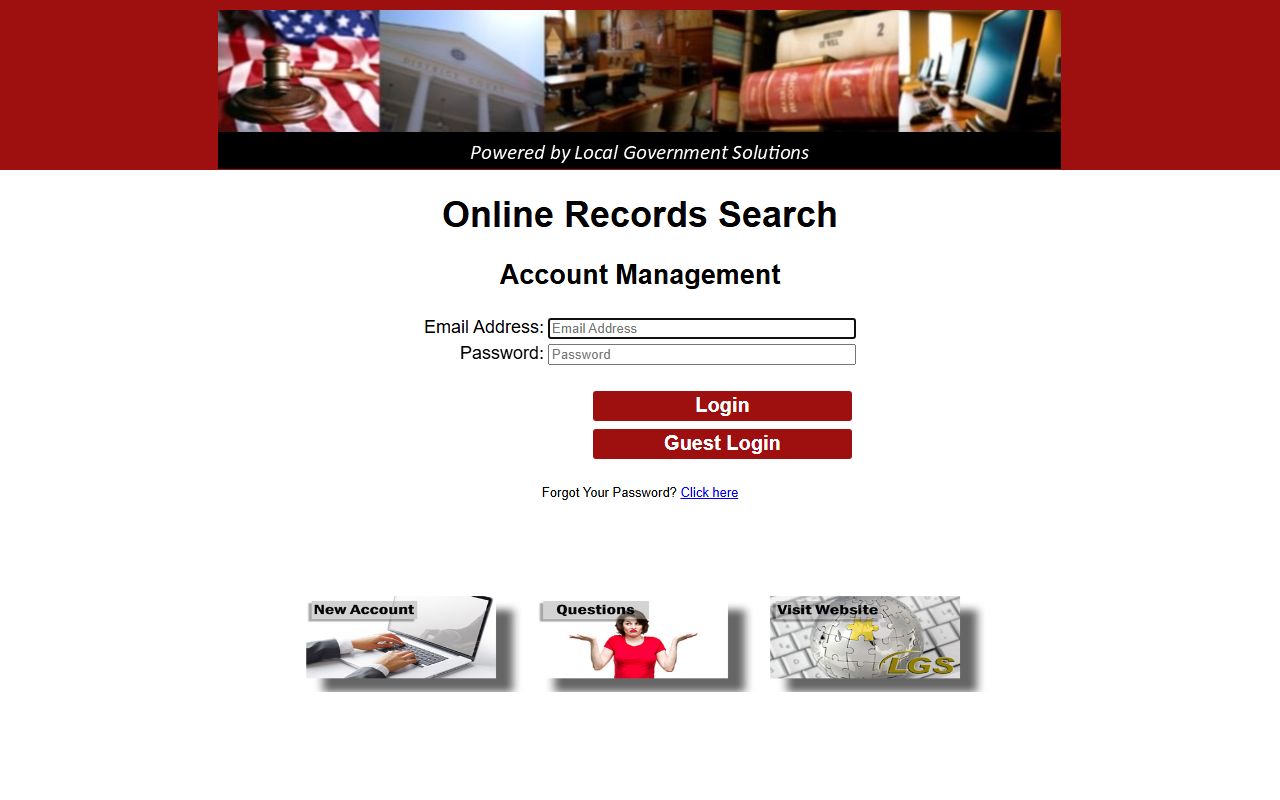
The portal is a court-record path, not proof of current jail custody.
Floyd County Case Search Fields
The LGS login screen has account fields and a guest-login option. The research did not capture a full case-result sample, so field claims should stay limited to the visible login controls and the District Clerk's case-number formatting note.
| Field Label | Type | Required | Notes |
|---|---|---|---|
| Email Address | Text | Required for registered login | The page script lowercases the input. |
| Password | Password | Required for registered login | Used by registered users. |
| Login | Button | Yes for account login | Submits the account credentials. |
| Guest Login | Button | Optional | Uses guest values where public searching is enabled. |
| New Account | Link/button image | Optional | Starts registration. |
The LGS login screenshot from the public login page shows the guest and account controls used before searching Floyd County court records after arrest.
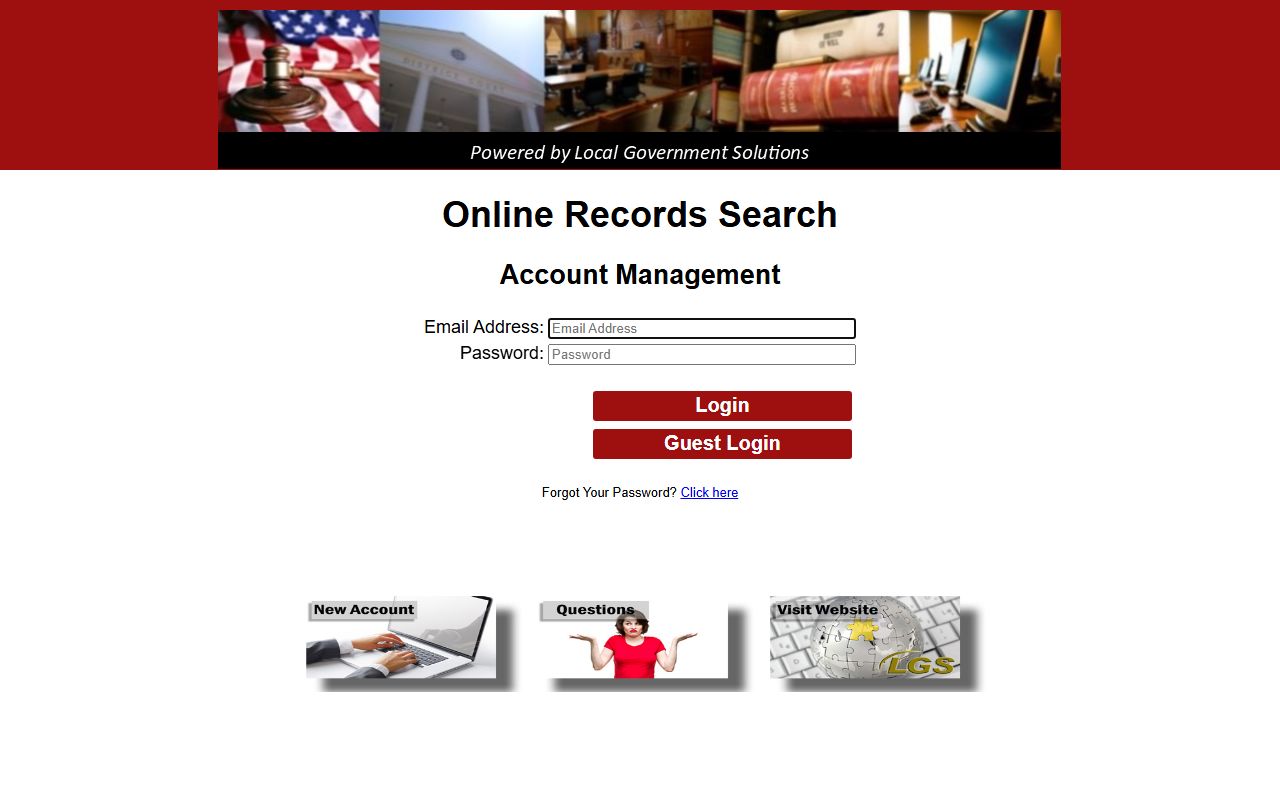
Use the clerk's official link when the session workflow is sensitive to how the portal is opened.
Floyd County Charging Documents
After arrest, law enforcement submits reports to the prosecutor. The 110th Judicial District Attorney, Emily Teegardin, serves Floyd County from the courthouse address listed in the research. The prosecutor may decline, file, amend, reduce, or pursue charges through a grand jury depending on offense level and evidence. Court records after a jail arrest should be read as the filed case record, not just the booking allegation.
| Document | Who Uses It | What It Means |
|---|---|---|
| Complaint | Law enforcement, prosecutor, or court process | A sworn allegation or charging document used to begin some criminal matters. |
| Information | Prosecutor | A prosecutor-filed charging instrument used for certain offenses. |
| Indictment | Grand jury | A formal charging instrument often used for felony prosecution. |
The official Floyd County District Attorney page lists the 110th Judicial District Attorney contact block.
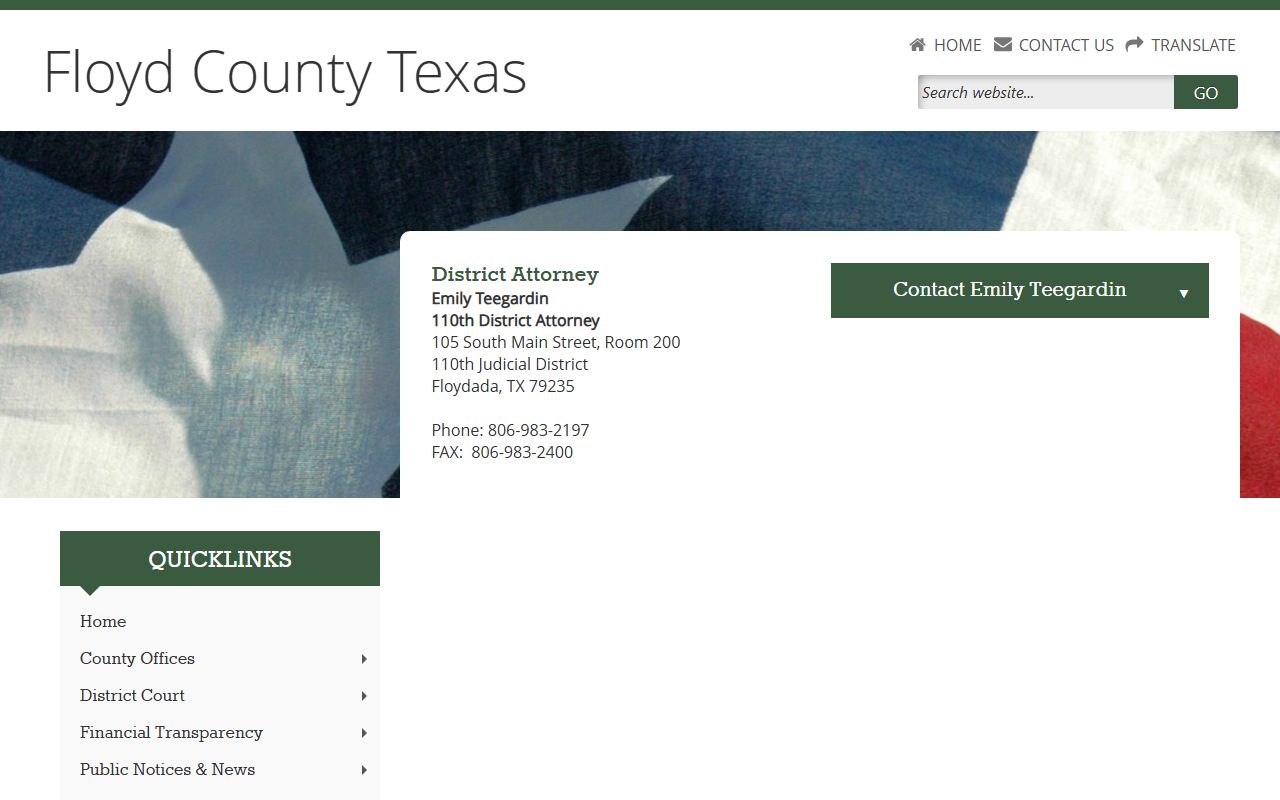
That office is the prosecution source, while the clerk system is the public case-record access point.
Floyd County Charge Status
Charge status can change after an arrest. A booking allegation can be broader, narrower, or different from the charge filed in court. A court record should be read for the current status of each count, the last docket action, and the disposition if the case has ended.
| Status | Meaning |
|---|---|
| Pending | The case or charge is open and has not reached final judgment or dismissal. |
| Amended or reduced | The filed charge changed from the original allegation or was lowered. |
| Dismissed | The charge was not pursued to conviction or was ended by court action. |
| Convicted | A judgment, plea, or verdict resulted in a conviction. |
| Transferred | The matter or custody issue moved to another court, county, state, federal, or immigration system. |
Note: An arrest is not a conviction; the conviction exists only after the court record shows a qualifying judgment or plea/verdict.
Bond in Floyd County Court Records
Texas Code of Criminal Procedure Chapter 17 governs bail, bond conditions, personal bonds, and release procedures. Floyd County-specific online bond-payment instructions were not located, so the sheriff and court phone channels matter. A magistrate may set bond based on the charge, criminal history, public safety, appearance risk, and statutory limits. A person can also have a bond on one case and remain held on another warrant or detainer.
| Bond type | Meaning | Floyd County action |
|---|---|---|
| Cash bond | Money deposited with the court or custodian. | Ask where payment is accepted. |
| Surety bond | Commercial bond posted through a licensed surety. | Verify eligibility and holds first. |
| Personal bond or PR bond | Release on written promise and court conditions. | Controlled by magistrate or court. |
| No-bond hold | No release on that hold until agency or court action. | Ask which agency controls the hold. |
Floyd County Warrants After Arrest
No official Floyd County active-warrant search page, sheriff warrant list, or app-only warrant search was confirmed. If a warrant led to the arrest, search court records for case status and contact the sheriff or issuing court. A bench warrant or capias often links to missed court or noncompliance. A fugitive or out-of-county warrant may create a hold even after local bond is set.
- Arrest warrant: Authorizes arrest on probable cause or charging process.
- Bench warrant or capias: Issued by a judge, often after failure to appear.
- Search warrant: Authorizes a search, not necessarily a custody record.
- Out-of-county hold: Another jurisdiction may request detention or transfer.
Charge vs Conviction Records
Court records after a Floyd County arrest can show allegations, not just final results. A charge is what the state accuses a person of committing. A conviction is the result of a plea, verdict, or judgment. Background research, employment screening, housing screening, and licensing uses have their own legal rules and should not rely on casual site content.
| Record point | Charge | Conviction |
|---|---|---|
| Timing | Appears after filing. | Appears after judgment, plea, or verdict. |
| Meaning | An accusation pending in court. | A final adjudicated outcome. |
| Can change? | Yes, it may be amended, reduced, or dismissed. | May be appealed, set aside, or affected by later relief. |
Sealed and Expunged Records
Texas Code of Criminal Procedure Chapter 55 provides expunction procedures for qualifying arrests and criminal records. The research did not find a Floyd County-specific removal policy. A dismissed case, expunction, sealing, or nondisclosure issue is a legal-record-relief question, not a promise that every public copy disappears from every location.
| Issue | Sealed or nondisclosed | Expunged |
|---|---|---|
| Basic effect | Access is restricted for many users. | Qualifying records may be removed or destroyed under court order. |
| Source | Texas court order or statute. | Texas Code of Criminal Procedure Chapter 55. |
| Practical step | Review the court order and agency response. | Use legal counsel or clerk guidance for eligibility and filing. |
Floyd County Clerk Contacts
The court-record pathway often requires a clerk phone call when the LGS portal does not show a case. The District Clerk contact and case-number note are especially useful for criminal case lookups. The County Clerk page lists public office hours of Monday through Thursday, 8 a.m. to 5 p.m., and Friday, 8 a.m. to 3 p.m.
District Clerk
105 South Main Street, Room 207
Floydada, TX 79235
806-983-4923
Fax: 806-983-4938
110th Judicial District Attorney
105 South Main Street, Room 200
Floydada, TX 79235
806-983-2197
Fax: 806-983-2400
Public Record Search
Sponsored Results